


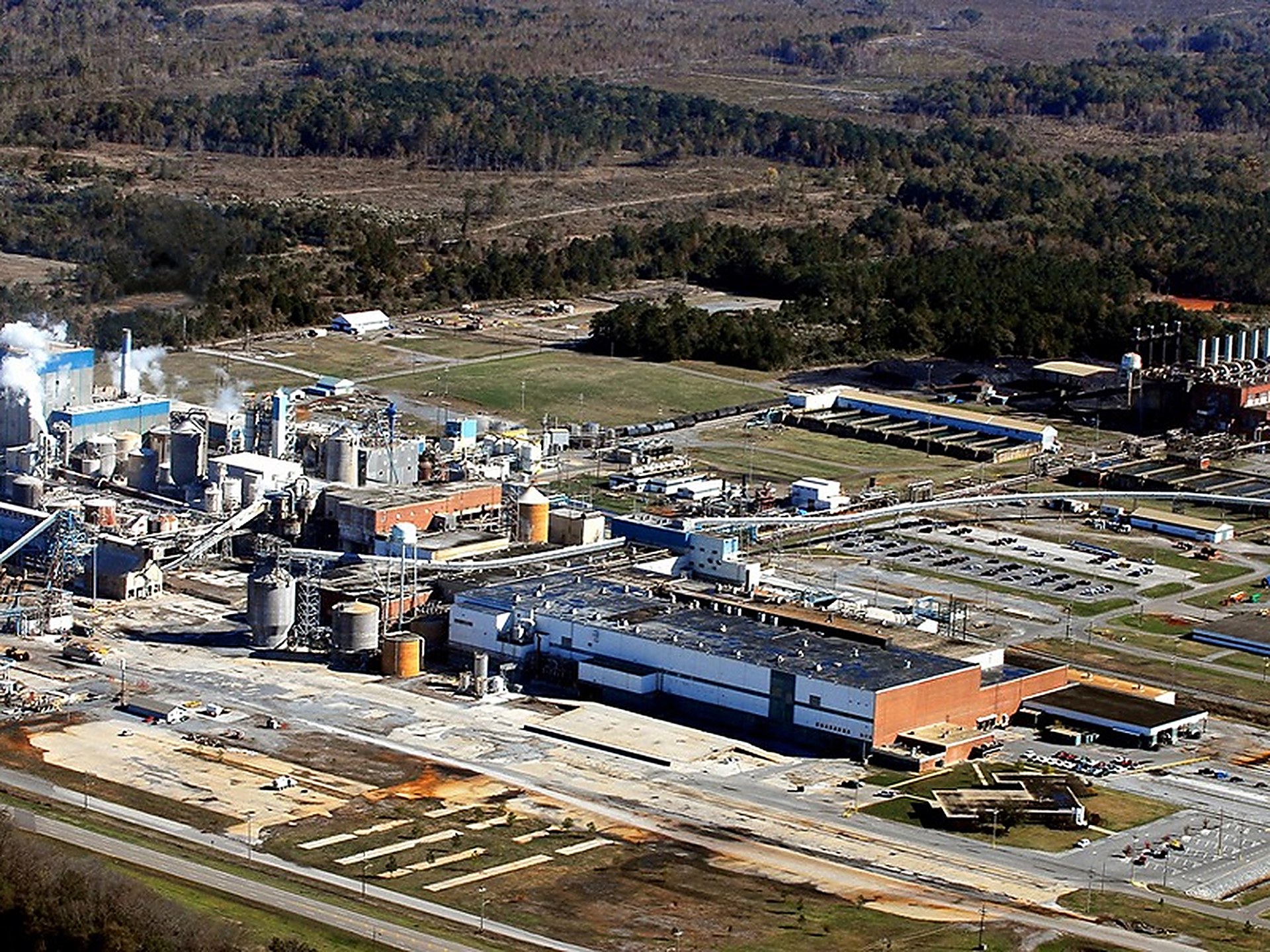
Rural Alabama stands to lose almost US$7 billion in economic activity over the coming decade, all of it from a single pulp mill on the Coosa River that stopped in May. That is according to new numbers run by Tom Richardson and Larry Wall, a forester and a financial adviser to timberland owners, who took them to Alabama’s congressional delegation before the Wall Street Journal reported the work earlier this month.
“One plant, I think, closed over in Georgia, which was right over the state line from Dothan in Houston County,” Marcus Paramore said in June, with the Republican representative for Troy counting thousands of Alabamians in two counties who drove over that line to work. Paramore helped sponsor the resolution creating the study commission lawmakers passed in April, a month before the mill stopped.
Domtar lists the Coosa Pines mill in Childersburg, Talladega County, with $569 million in annual economic impact and 270,000 metric tonnes of annual market pulp capacity on the fact sheet it publishes for the site. Most of that figure is the mill’s own impact spread over ten years, the Journal reports, with the rest falling on the million acres of timberland southeast of Birmingham that it bought wood from.
Fluff pulp is the fibre inside nappies and sanitary products, and Coosa Pines made it from 1976 on a kraft line added to a newsprint plant that had been running since 1950. Domtar’s March announcement cites “difficult market conditions, as well as its aged assets“ at the site.
Domtar’s 24 March announcement carried no headcount. Sylacauga News reported 285 positions that day; the Journal counts more than 250 workers who lost jobs, and Domtar’s own fact sheet staffs the site at 275.
Mills across the US South paid $29.02 a ton for delivered pine pulpwood through the June quarter while the stumpage reaching the landowner fell to $5.40, on TimberMart-South’s count. The grower is paid last, after the contractor has deducted cutting and haulage from the delivered price, so that number moves the furthest when a mill stops buying. Harvesting contractors also make fewer, longer trips to more distant mills once the nearby one closes, and Richardson and Wall counted that cost too.
Russell Johnson has told the commission that transportation costs and a shrinking number of mills have cut the value of pine pulpwood across parts of southeast Alabama. The Pike County Commissioner co-owns Coastal Plain Land and Timber and sits on the commission himself.
Six pulp mills across Texas, Florida, South Carolina, and Georgia have closed permanently inside five years, seven University of Georgia researchers counted in the Journal of Forestry in May, among them International Paper’s Georgetown operation. Coosa Pines is idled indefinitely rather than closed, and Domtar has not revisited that wording since March.
It comes as Domtar idles 400 jobs and 380,000 metric tonnes of northern bleached softwood kraft at Port Mellon in British Columbia by mid-October. Canfor confirmed the permanent closure of its Northwood mill in Prince George in July, removing 300 jobs and 300,000 tonnes of kraft capacity from the province.
As it stands, the commission Alabama lawmakers created in April first met on 22 June, more than two months before Richardson and Wall’s figures began circulating. TimberMart-South has recorded delivered pine pulpwood under $30 a ton for four consecutive quarters.
Author
The Daily Digest
Get Wood Central's top timber stories in your inbox every weekday
Join thousands of forestry, timber and building professionals who start their day with the Daily Digest. It's free, and you can unsubscribe at any time.

