
Overseas manufacturers are selling more wood into Australia without a building boom behind them, with imports of major wood products up 10.8 per cent to $1.941 billion in the 2025-26 financial year. That is according to The Precinct, the timber manufacturing project planned for Portland in south-west Victoria, which in a new white paper on Monday traced the rise to “a deeper shift in the products being specified, purchased and used in Australian construction.”
“The market is rapidly forming now, but the majority of the manufacturing capacity supplying the demand is being delivered offshore,” The Precinct said, calling it “the central issue Australia needs to confront.” IndustryEdge, which leads the project’s delivery, found that engineered wood products and builders’ joinery together accounted for $676.9 million of that import bill, up 6.2 per cent on the previous year.
Approvals for four-to-eight-storey buildings jumped 70.5 per cent in 2025, while house approvals rose just 1.9 per cent over the same year. Townhouse approvals climbed 20.5 per cent, and The Precinct said those denser buildings create an opportunity for products that can be “engineered, standardised and manufactured off site.”
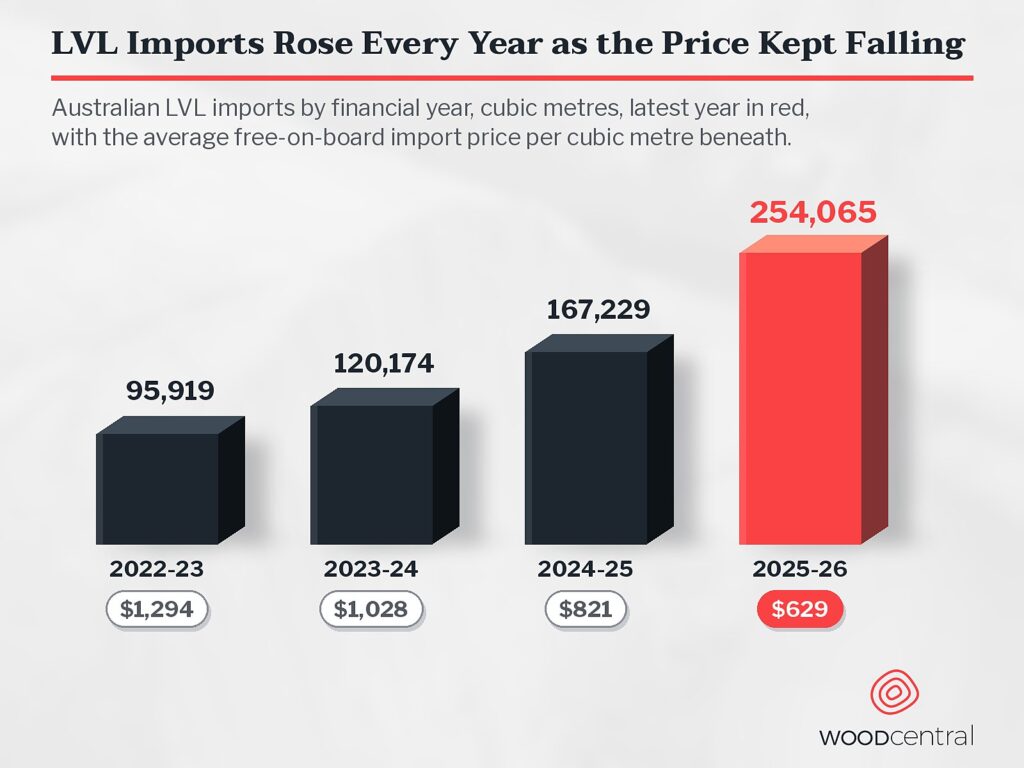
Its clearest example is laminated veneer lumber (LVL), with formally reported imports reaching 254,065 cubic metres in the 2025-26 financial year, more than 160 per cent above the 95,919 cubic metres of three years earlier. Average import prices for LVL fell to $629 a cubic metre over the same year, down from $1,294 in 2022-23, even as the value of those imports climbed to $159.9 million.
According to The Precinct, rising volumes at falling prices are a sign that overseas manufacturers are “not simply supplying a temporary shortfall, they are establishing a stronger position in the Australian market.” It also estimates that total LVL imports will exceed 300,000 cubic metres per year in the near term, beyond the reported figure.
It comes as Australia’s timber importers warned this month that border data cannot separate a laminated beam from a plywood sheet, with both products entered under the same tariff heading. LVL had no line of its own in that heading until 2022, and a beam keyed to a plywood line is still counted as plywood all the way to the Australian Bureau of Statistics.
Plywood imports also rose, to 656,014 cubic metres in the 2025-26 financial year from 525,599 cubic metres, while medium-density fibreboard climbed to 183,547 cubic metres from 122,921. Average import prices fell for both to their lowest in five years, with the project describing every engineered timber product made overseas as “value that has been created outside Australia.”
At the same time, imports of prefabricated building products rose 52.6 per cent in 2025 to $333 million, and reached almost $226 million in the first four months of this year. Most of that trade has been steel and other non-wood buildings, from cold rooms to carports, although the project said the trend shows Australia is “increasingly importing complete or partially completed dwellings.”
Federal funding for The Precinct flows through Australian Forest and Wood Innovations (AFWI) in partnership with the Victorian Government, with both governments announcing a joint $2.95 million research investment last December. They tasked AFWI with leading the feasibility study, and Australian Bluegum Plantations, OneFortyOne, Timberlink Australia, and WTI Beam are among the project’s industry partners.
Green Triangle plantations, spanning south-west Victoria and south-east South Australia, already grow the hardwood that The Precinct’s first white paper argued in August should become engineered wood made right here at home, not just export woodchips. The project says exports will remain part of that trade, with engineered wood made in the region to “complement those exports” rather than replace them.
Institutional investors will hear the case in Melbourne on Wednesday 14 October at an invitation-only symposium, where Tim Woods, the IndustryEdge managing director leading The Precinct, is among the keynote speakers. The Precinct said Australia’s market is “already demonstrating where the opportunity lies”, and that “it’s time for the sector to deliver the answers.”
Author
The Daily Digest
Get Wood Central's top timber stories in your inbox every weekday
Join thousands of forestry, timber and building professionals who start their day with the Daily Digest. It's free, and you can unsubscribe at any time.