

It’s official. Wood, pulp, paper, and packaging must be EUDR-ready from 30 December, after the European Parliament and the Council allow their two-month veto period on the revised product list to expire on Sunday, 13 September. It comes as the European Commission’s own 95-page FAQ, now in its fifth version, still describes the exemptions for second-hand goods and samples as proposals in a draft.
“The suggestion to remove wood residues and sawmill by-products falling under HS code 4401 could not be accommodated,” the 13 July delegated act states. Those products were already regulated under the old EU Timber Regulation, the Commission found, and the request lacked the backing of the industries it would have covered.
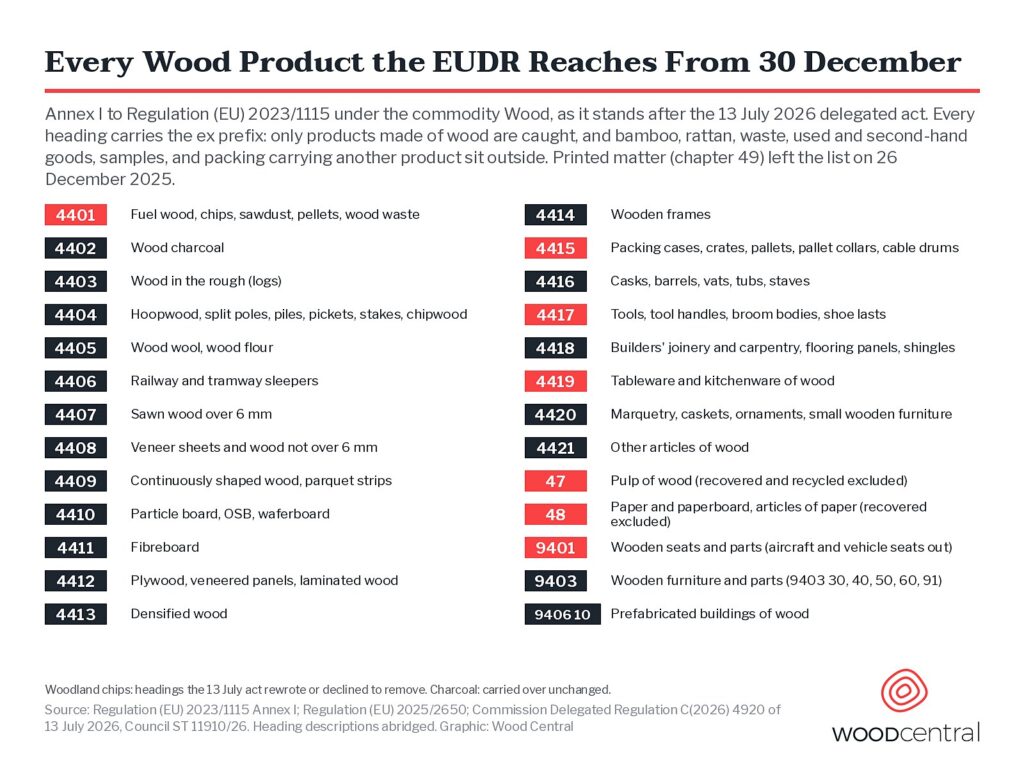
Timber remains within the law as one of seven commodities, with wooden tools and kitchenware under headings 4417 and 4419 kept on the list, and printed books left off it. Stakeholders won six of the 25 product-code changes they requested, and a bid to add wood-plastic composites was among the 19 that were refused after it failed the Commission’s cost-benefit test.
Packing sits outside the regulation only while it supports, protects, or carries another product, and the Commission’s test is whether customs would classify the packing together with the goods inside it. Wooden packing under heading 4415 already had that carve-out, and the act extends it to single-use and reusable packing under every other heading on the list.
A new pallet sold on its own is a relevant product and takes a due diligence statement, while a pallet moving loads inside a closed exchange pool is not, the Commission says. A repaired pallet put back on sale carries obligations only for the new wood used in the repair, with its vendor an operator or a downstream operator depending on whether that wood has already cleared due diligence.
Brussels ruled out stretching the exemption to replacement, return, repair, and service packaging, or to point-of-sale and promotional displays, a request it said: “could have created a potential loophole”. Packing that enters the EU under load and is later sold or rented out empty is not subject to the regulation, according to the FAQ, whether or not the goods it carried were subject to it.
Paper and paperboard made entirely from material that has completed its lifecycle fall outside the regulation, while a product containing virgin pulp or a manufacturing by-product, such as box-plant scrap, falls within it. The operator first placing that fibre on the market traces it to the plot, and recovered paper under chapters 47 and 48 is exempt as waste and scrap.
A company that harvests its own forest and pulps the logs inside one legal entity owes due diligence only when the pulp is sold, since a transfer between two of its branches is not a supply. A company burning its own wood chips for heat, or buying chips already covered by a statement to make electricity, is not subject to the regulation at all.
Wood must meet both tests after 31 December 2020, with no deforestation on the plot and no forest degradation resulting from the harvest. A stand degraded by fire, storm, or disease can still supply compliant wood where the felling did not cause the change, and salvage harvesting is not treated as inducing degradation.
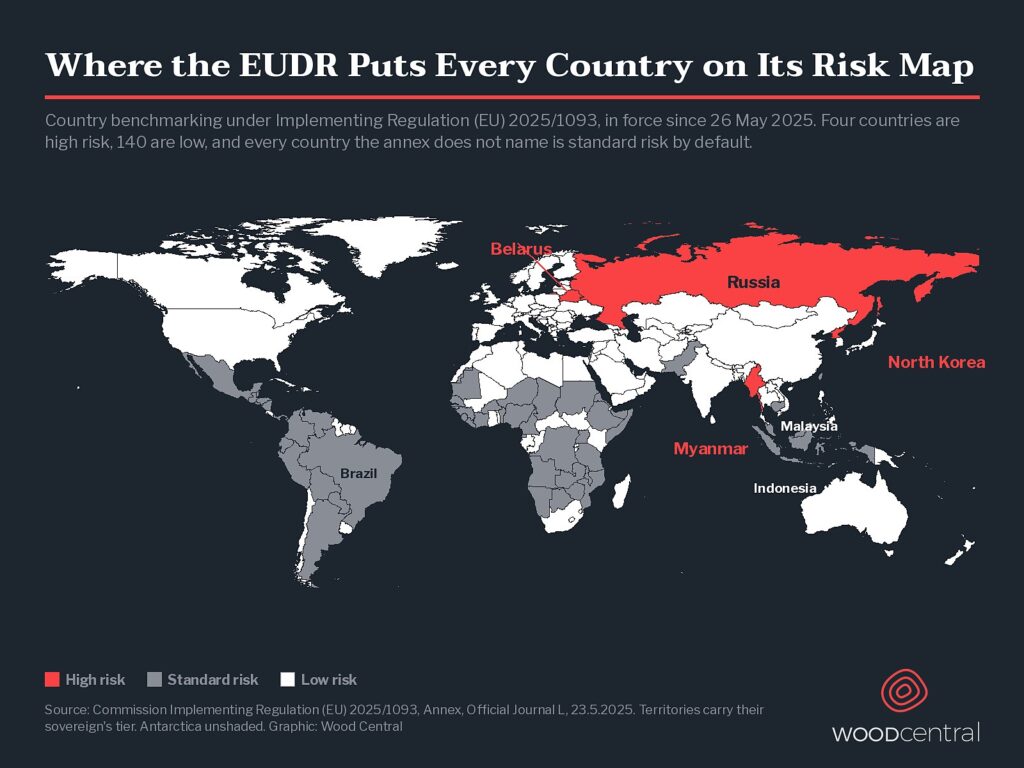
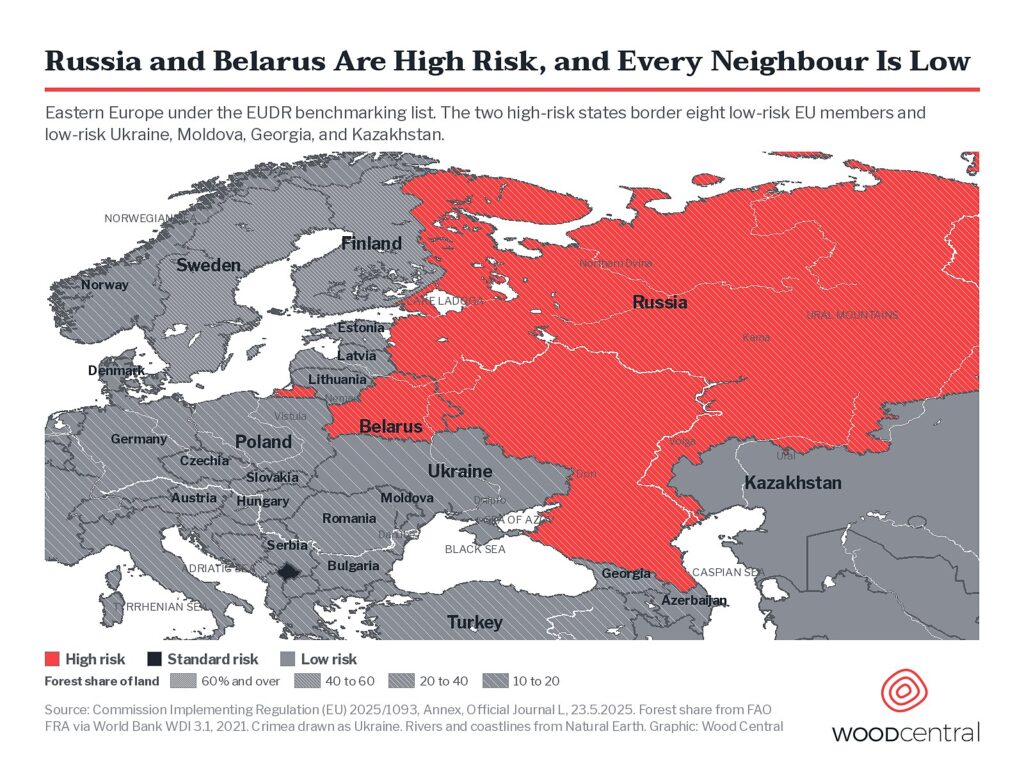
Where the wood was harvested sets the paperwork, with four countries listed as high risk, 140 as low, and every other country standard by default under the benchmarking list of 22 May 2025. Australia, Canada, China, and the United States sit on the low-risk list beside every EU member state and the transhipment hubs of Singapore and Hong Kong, while Brazil, Indonesia, and Malaysia are standard.
Standing trees fall outside the regulation, and a harvesting contractor is the operator only where it owns the logs the moment they are felled, not where ownership passes to it afterwards. A statement on a log sale falls due once the logs are available, the sale is agreed, and loading starts, with the full scientific name of the species mandatory on every wood product.
Large and medium operators comply from 30 December, joined by micro and small firms in timber, while the smallest firms in every other sector follow on 30 June 2027. Products the act adds face the law only from 30 December 2027, and wood harvested before 29 June 2023 stays under the old timber rules, with felling tickets accepted as proof of the date. Member states must set their maximum fine at no less than 4 per cent of a company’s EU-wide annual turnover.

The act itself enters into force on the day after it appears in the Official Journal of the European Union, and the Commission will review every product it moved at the regulation’s general review in 2030. “No additional guidelines are necessary to comply with the rules,” the FAQ states.
Author
The Daily Digest
Get Wood Central's top timber stories in your inbox every weekday
Join thousands of forestry, timber and building professionals who start their day with the Daily Digest. It's free, and you can unsubscribe at any time.