


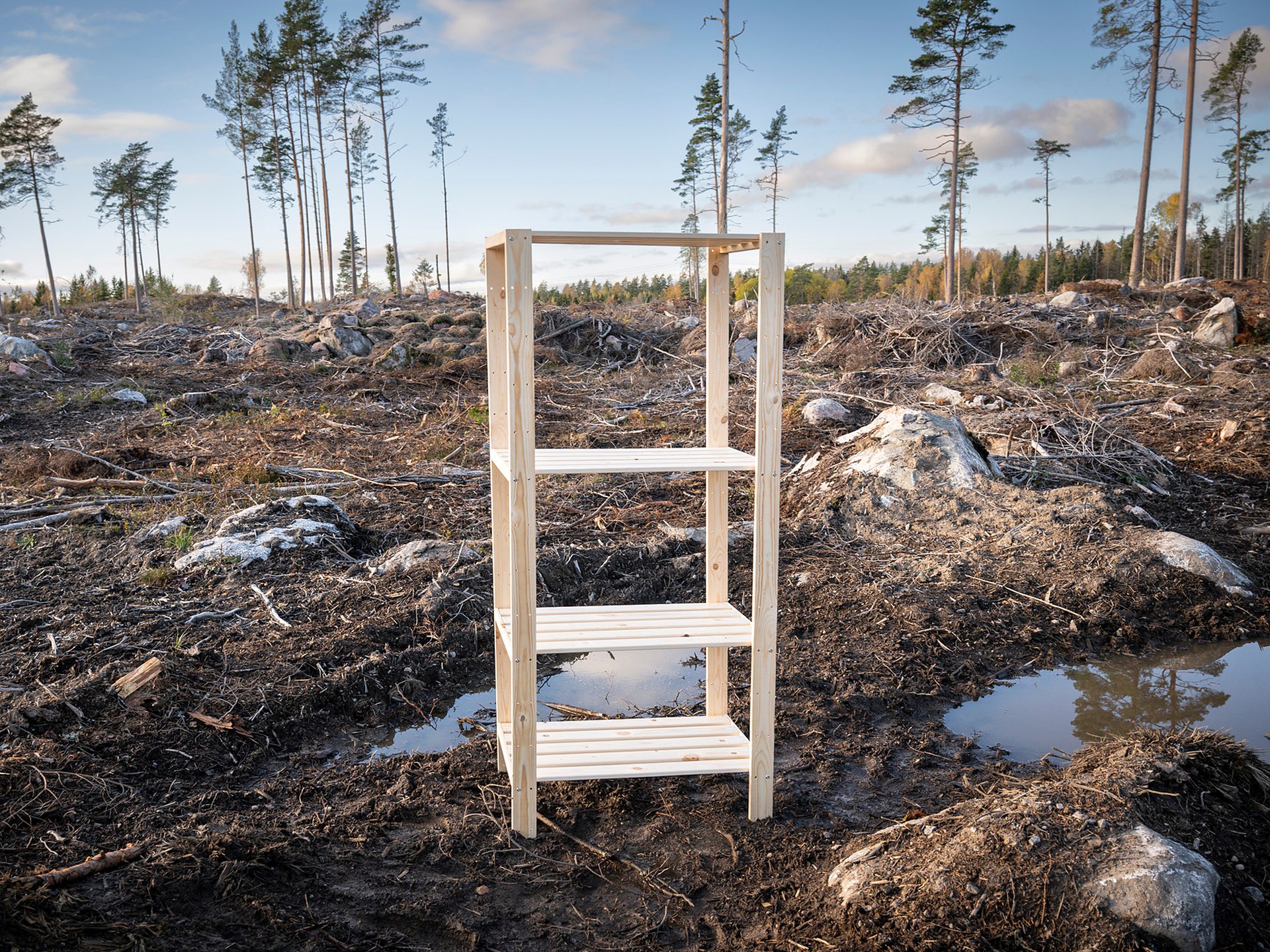
Pine from forests that Sweden’s Forest Agency says cannot be recreated in the foreseeable future is ending up in IKEA’s furniture, with 26,000 hectares of such forest still harvested across the country every year. That is according to Greenpeace Nordic, which said on Tuesday that the wood is “highly likely to regularly enter” the retailer’s production, three weeks after Greenpeace linked IKEA to a felled Romanian natural forest.
“No shelf or chair in the world is more important than saving irreplaceable forests. Ikea could make that decision today,” said Frida Bengtsson, head of Greenpeace in Sweden. She said IKEA needed only to tell its suppliers to keep out of these forests, with Greenpeace calling on the retailer to exclude every remaining continuity forest in Sweden from its supply chain.
To trace the wood, Greenpeace’s investigators drilled numbered smart tags into logs from eight clear-felled sites mapped as continuity forest, meaning woodland with no history of clear-cutting, and tracked them in April and May. Logs from six sites in Norrbotten, Sweden’s northernmost county, reached SCA’s Munksund sawmill in Piteå, whilst logs from two in Västernorrland reached its Bollstabruk sawmill.
They then found Munksund pine at Hedlunda Industri, which manufactures IVAR in Lycksele, and mapped Bollstabruk’s timber through SCA to TräTeam, the HEJNE manufacturer in nearby Kramfors. SCA first agreed in 2009 to supply IKEA with one million HEJNE shelves a year, with Greenpeace finding its export code, 21324, on Made in Sweden flatpacks in IKEA stores in Sweden, Germany, and Slovenia.
Overall, Sweden supplies 8 per cent of IKEA’s wood, according to Greenpeace, with the world’s largest furniture retailer using nearly 12 million cubic metres of fresh timber in its last financial year. Other brands have already acted, with Nestlé, Zalando, and L’Oréal announcing plans since November last year to phase SCA’s wood fibre out of their packaging after criticism of its impact on nature and Sámi rights.
“We do not agree that continuity forests are automatically forests worthy of protection,” wrote Mattias Hennius, media manager at Inter IKEA Group, in an email to a Swedish newspaper. He said the timber was harvested in line with the law and IKEA’s FSC certification requirements, and that the retailer sees no reason to change its wood sourcing requirements because of the report.
Greenpeace does not dispute that, arguing instead that obeying the law and holding an FSC certificate are no guarantee the wood comes from forests where harvesting is ecologically sound. The group, which has investigated IKEA’s European supply chains before, also says FSC certification in Sweden “functions as a mechanism for corporate greenwashing”, a charge FSC has rejected as “not supported by facts”.
SCA, which carried out the harvesting, has also dismissed the investigation, with Ola Kårén, its head of silviculture, telling Swedish public television on Tuesday that it was weak and “directly misleading”. The company, which says it is Europe’s largest private forest owner, said late last year that an independent audit had found its forestry still met FSC’s standard, months after it put a planned pause in that certification on hold.
As it stands, IKEA wants decisions on which further Swedish forests to protect made through open, science-based processes, pointing to its work inside FSC Sweden and urging Greenpeace to take part. FSC, for its part, says certification bodies have terminated the certificates of 18 certificate holders in Sweden since April, with a revision of its Swedish standard under way since March.
Author
The Daily Digest
Get Wood Central's top timber stories in your inbox every weekday
Join thousands of forestry, timber and building professionals who start their day with the Daily Digest. It's free, and you can unsubscribe at any time.

