

New Zealand is eyeing off India as a new market for radiata pine products, with the value chain pitching sawn timber and engineered wood products to Indian buyers alongside the logs that have so far dominated trade. It comes days after New Zealand’s Parliament passed legislation to enact the free trade agreement, which Trade and Investment Minister Todd McClay signed with India’s Commerce and Industry Minister Piyush Goyal.
It comes as wood processors and scientists took that pitch to MumbaiWood last week, where they exhibited under the New Zealand pavilion at a three-day woodworking fair. Among them was Dr Henri Bailleres, who heads forests-to-timber products at New Zealand’s Bioeconomy Science Institute, and used the fair to meet Dr Shakti Chauhan, director of India’s Institute of Wood Science and Technology.
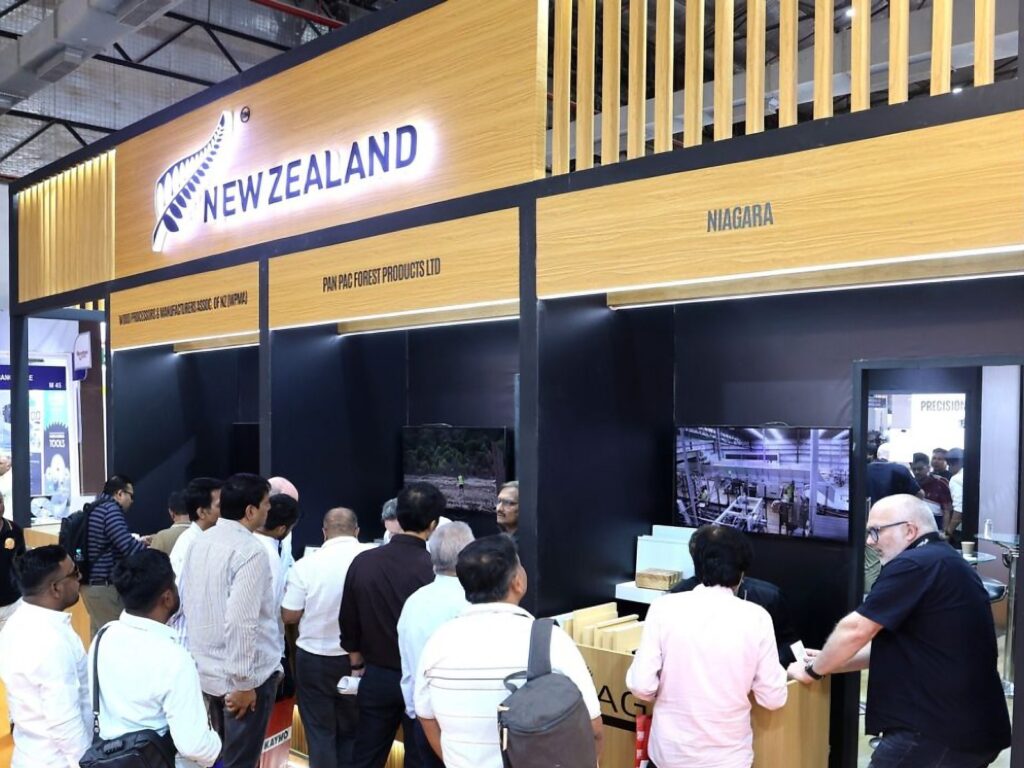
According to Bailleres, the two countries could work together on everything from joint research to “fumigation protocols and market access.” Those protocols matter in India, where New Zealand’s radiata pine trade peaked at $326 million in 2019 before a methyl bromide dispute cut it to $9.5 million by 2023 (it has since been restored after logs were allowed to enter again in early 2025).
Whilst wood exports to India have tripled to $193 million over three years, logs still account for $122 million of that total. To lift the value of that trade, New Zealand Trade and Enterprise is urging exporters to lead with engineered wood products and seasoned, graded timber in a country that imports only 10 per cent of its timber needs.
Sawmills began fielding more Indian enquiries for sawn timber within weeks of the April signing, the New Zealand Timber Industry Federation reported at the time. The federation said processing capacity and ongoing industry engagement would determine whether those enquiries translate into sustained export volumes.
More than 95 per cent of New Zealand’s forestry and wood products will enter India tariff-free once the agreement, ratified by both governments on Monday, takes effect next month. As it stands, most wood lines are charged duties of between 5.5 and 11 per cent, and duties on the remaining lines will be phased out over seven years.
McClay said the deal would “level the playing field and unlock access for Kiwi businesses” in an economy of 1.4 billion people.
“We share a strong, solutions-focused approach: connecting research with industry, advancing wood-product innovation, and removing technical barriers that can unlock trade,” Bailleres wrote after the fair.
Related reading: PEFC Group Certification Could Give NZ Growers a New Path to Market
Author
The Daily Digest
Get Wood Central's top timber stories in your inbox every weekday
Join thousands of forestry, timber and building professionals who start their day with the Daily Digest. It's free, and you can unsubscribe at any time.