
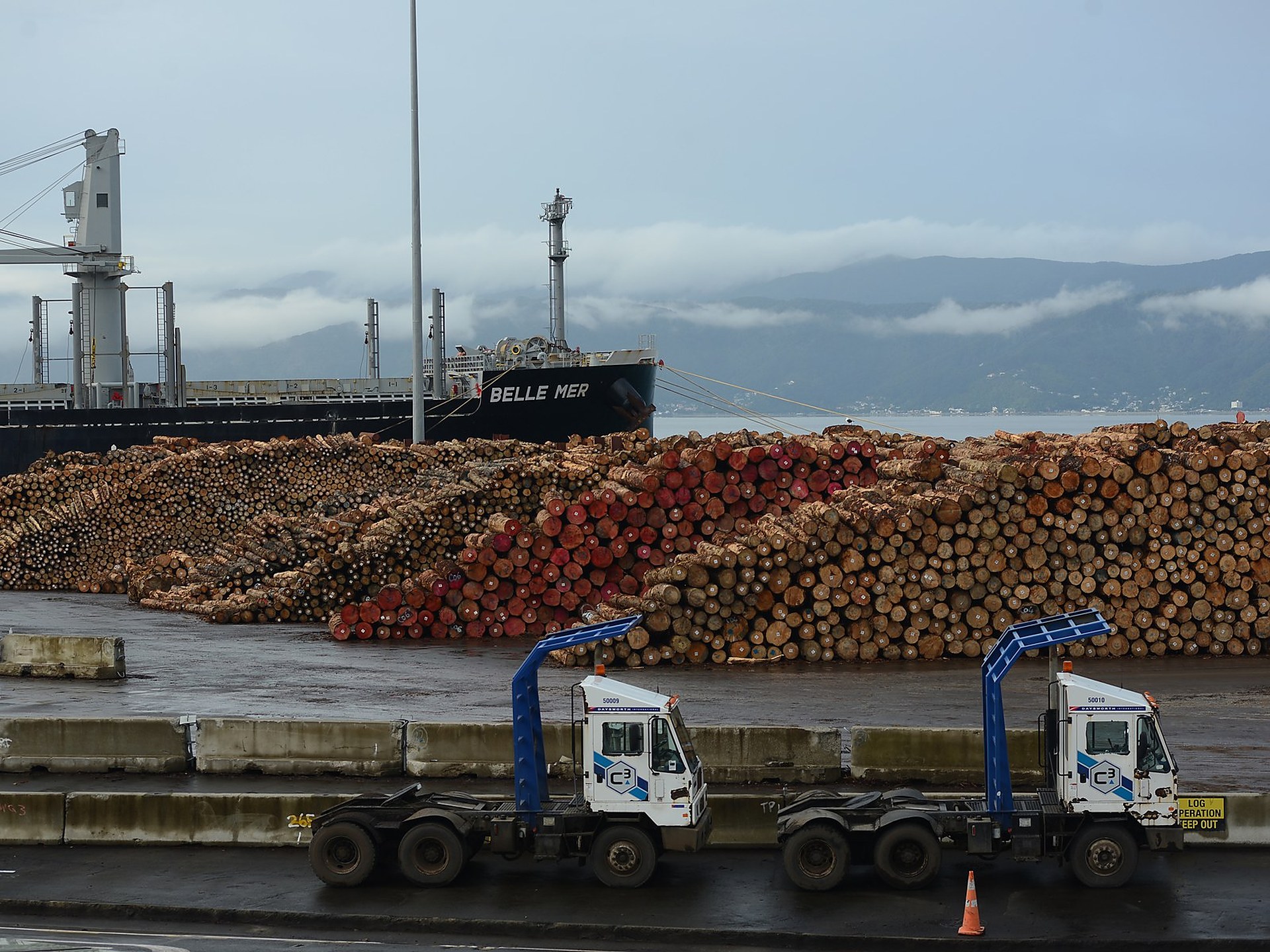
New Zealand wood earned more in China, with logs, wood, and wood articles up NZ$40 million in August last year, the biggest rise of any export to China. That is according to Stats NZ, which reported on Friday that exports to China climbed $191 million, or 16 per cent, with milk powder, butter, and cheese next on $37 million.
However, “ocean freight costs remain elevated, and the NZD has strengthened against the USD during August, both of which will place downward pressure on AWG returns,” according to Scott Downs, Head of Sales and Key Clients at Stand Forestry. In his August log market report, Downs found at-wharf-gate (AWG) prices for export logs at New Zealand ports unchanged from July.
In China, CFR (cost and freight) prices for A-grade New Zealand logs firmed by a few dollars to US$125-$130 per JASm³, Downs reported. The yuan gained 6.4 per cent on the US dollar over August, which he said had “increased the purchasing power of the Chinese log buyers.”

Softwood log inventories in China dipped slightly but were otherwise stable, he said, while daily log offtake held at 55,000 cubic metres. It follows a softer May, when weak furniture and construction sales in China forced exporters to give ground on the premiums they hold for furniture-grade logs.
Adding to costs for New Zealand exporters, freight for a vessel loading at two North Island ports and sailing to China runs in the high US$40s per JASm³, Downs said. At the same time, the New Zealand dollar gained 3 per cent on the US dollar over August, a move he warned would weigh on AWG price calculations for log suppliers.
More broadly, China’s property developers broke ground on 267 million square metres of new floor space in the seven months to July, 24 per cent less than a year earlier, the National Bureau of Statistics reported in August. That is a steeper fall than the 23.4 per cent the bureau recorded through June, with homes accounting for 194.9 million square metres of the starts.

Looking further ahead, Downs warned that Beijing’s new five-year forestry plan could, over the longer term, cut China’s need for imported softwood logs. Beijing is aiming to lift forest cover to 25.8 per cent and total forest stock to 22.4 billion cubic metres by 2030, he said.
That is “particularly relevant for New Zealand, given China’s dominant share of our export log market,” Downs said, although new forest will take time to become harvestable wood. Chinese-grown logs have “traditionally struggled to compete with New Zealand radiata pine in higher-value grades”, he said, so extra Chinese wood is more likely to rival lower-grade industrial logs.
Downs said New Zealand needed to develop alternatives such as India and Southeast Asia while protecting its edge in higher-quality radiata grades. Unsold pine logs were still sitting in bonded yards at India’s Kandla port in August, however, and a more meaningful recovery is not expected until mid-November, after the monsoon and Diwali, he said.
Author
The Daily Digest
Get Wood Central's top timber stories in your inbox every weekday
Join thousands of forestry, timber and building professionals who start their day with the Daily Digest. It's free, and you can unsubscribe at any time.